Rethinking the SOP: Why Documentation Belongs Inside the Work
Every property management company has SOPs. And every property manager has ignored them.
When LaunchEngine started, the team used traditional documentation stored in Notion. While organized and visually appealing, a critical problem emerged: team members would open workflows in monday.com or Buildium, then switch tabs to Notion to locate instructions.
The core issue wasn't non-compliance. It was that processes existed separately from where work happened.
The Challenge
Managing multiple client workspaces in monday.com with distinct automations, integrations, and edge cases created friction. Separate documentation became quickly outdated as workflows evolved. New employees experienced longer onboarding periods.
The system had simply outgrown static documentation approaches.
The Turning Point
Rather than improving existing documentation, the team posed a transformative question: "What if the documentation lived inside the workflow itself?"
This concept became Workflow-Driven SOPs.
Instructions were embedded directly into monday.com workspaces using Item Cards containing both processes and contextual information. Each card functioned as a self-contained playbook with:
- Step-by-step guidance for every action
- Tabs for different scenarios (Occupied vs. Vacant onboarding)
- Info boxes explaining the reasoning behind each step
- Buttons triggering automations or Buildium synchronization
The Case: The Renewal Workflow
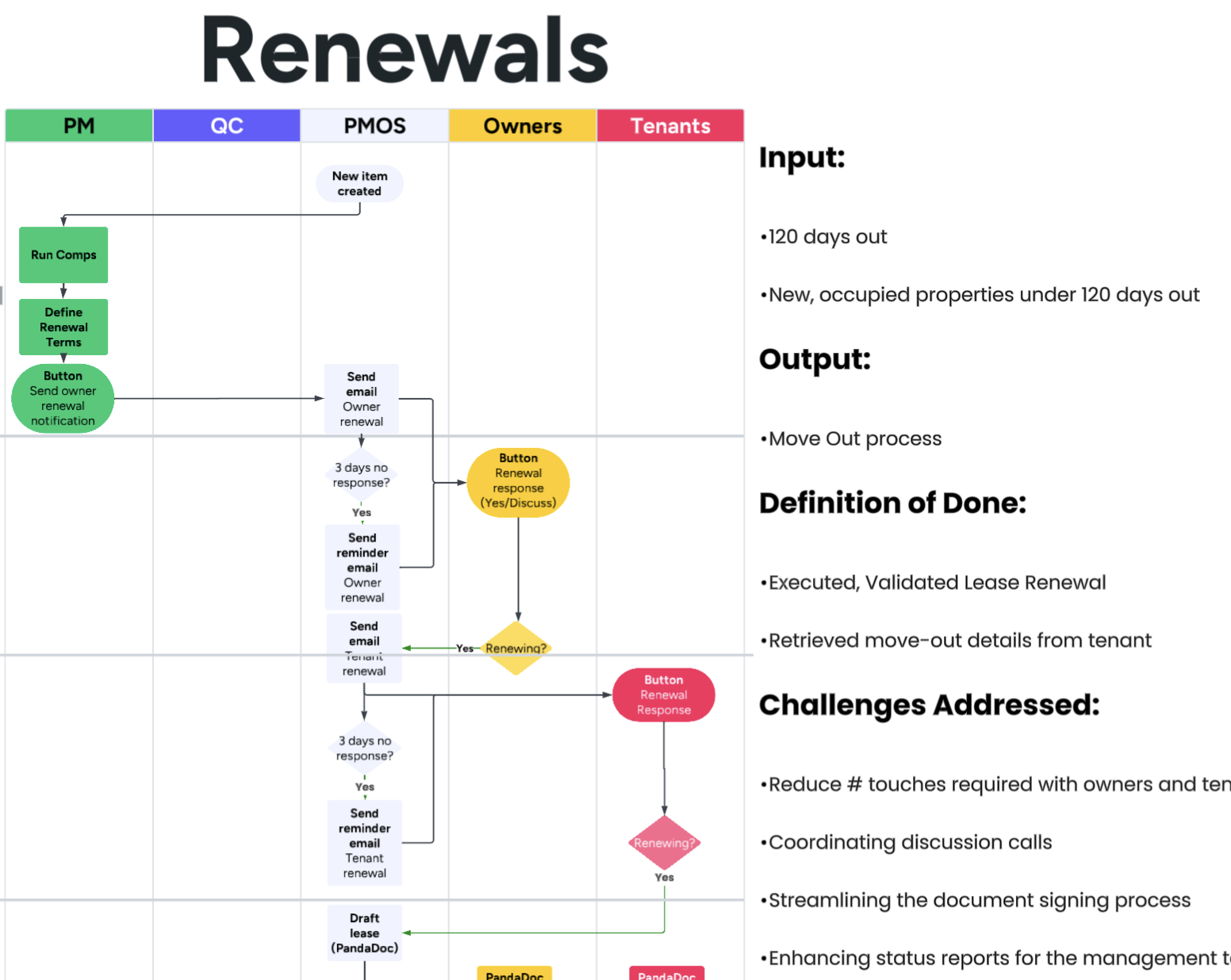
Previously, the Renewal SOP existed in Notion with eight steps, screenshots, and file links. Despite comprehensive organization, team members still navigated between applications.
After implementation, the entire process resides within monday.com. Opening a renewal item displays everything necessary directly in the Item Card. No system switching, no skipped steps.
What Changed After the Switch
Following six months of implementation across multiple client accounts:
- Training time decreased by 50 percent. New team members learned processes through direct system engagement rather than external reading materials.
- Process accuracy improved dramatically. Built-in workflow steps eliminated confusion about scenario-specific applications.
- Updates became effortless. Workflow changes updated live item cards instantly across the entire team.
- Adoption increased. Team members preferred this format since procedures remained immediately accessible.
How This Fits Into the Bigger Picture
Operations documentation has evolved through distinct eras:
The PDF Era: Word documents, printed binders, shared drives. Immediate obsolescence upon process changes.
The Wiki Era: Notion, Confluence, Google Docs. Superior organization but disconnection from daily work.
The Workflow Era (Today): Interactive workspaces like monday.com. SOPs built directly into workflows, updated in real time, connected to data and automations.
Documentation surrounding work creates friction; documentation within work creates flow.
What We Learned
- Documentation delivers value only when located where work occurs.
- Interface clarity accelerates adoption rates.
- Self-updating SOPs outperform manually maintained versions.
Where SOPs Are Headed Next
AI-driven automations increasingly observe patterns, identify exceptions, and recommend next steps automatically.
Future systems might detect delayed renewals and prompt appropriate procedures, or adapt workflows based on unit status. Property management operations are approaching self-improving, adaptive, contextual systems.
The SOP isn't going away. It's growing up. Future SOPs won't occupy shelves or Notion workspaces. They'll guide teams directly within software they use daily.